


Escolher uma escola é escrever uma história
Saiba como a Móbile pode contribuir para o projeto de vida de seu(sua) filho(a).
Consulte nossa equipe para saber sobre a disponibilidade de vagas para 2026.
Passo a passo para a matrícula na Móbile
Consulte nossa equipe de admissões para ingresso no decorrer do ano letivo.
Conheça a Móbile
Participe da reunião virtual e agende um encontro pedagógico ou visita.
Manifeste Interesse
Formalize sua intenção de matrícula preenchendo a ficha de manifestação na Área do Ingressante.
Reserve a sua vaga
Infantil 2 ao 5
O critério para o ingresso nessas séries é a ordem de entrega da manifestação de interesse.
1° e 2° ano Fundamental
O critério para o ingresso nessas séries é a ordem de entrega da manifestação de interesse. As crianças participam, ainda, de uma vivência não classificatória.
Mostre seu conhecimento
3º ano do Ensino Fundamental ao 3º ano do Médio
Após a participação em vivências ou avaliações, os(as) estudantes são chamados para iniciar a matrícula.
Realize a matrícula
Formalize o ingresso de seu(sua) filho(a) na Móbile.
Área do ingressante
Acesse nossa plataforma para acompanhar a evolução do processo de ingresso de seu(sua) filho(a).
What our
former students say

Nickolas Kokron
Graduated in 2012, getting his Doctorate degree in Physics at Stanford University
“Móbile contributed to the person I’ve become in different ways. In the academic aspect, it gave me the fundamentals to study in a course that is very demanding, Molecular Physics at USP. In a broader sense, it made me always follow what is happening around the world. Personally, I have great friendships and lived my first loves at Móbile School.”

Thais Alves Braga
Graduated in 2008, executive chef at Manioca
“At Móbile, I graduated as a thinking being, with autonomy and responsibility to develop an idea and get on with a project. I carry, kindly, memories of the exchanges and talks I had with the teachers and coordinators back at school.”

Pedro Sant'Anna
Graduated in 2016, getting his Doctorate degree in Economy at MIT
“Having studied at Móbile ever since I was young, I was encouraged to reflect about the world and think creatively, at the same time I had a solid academic foundation. I can see clearly how the many seeds of what I do as an economist were planted in school. In High school for example, I developed a research of scientific initiation that awakened my interest in racial inequality issues. The theme is now an important part of my investigation agenda at MIT.”
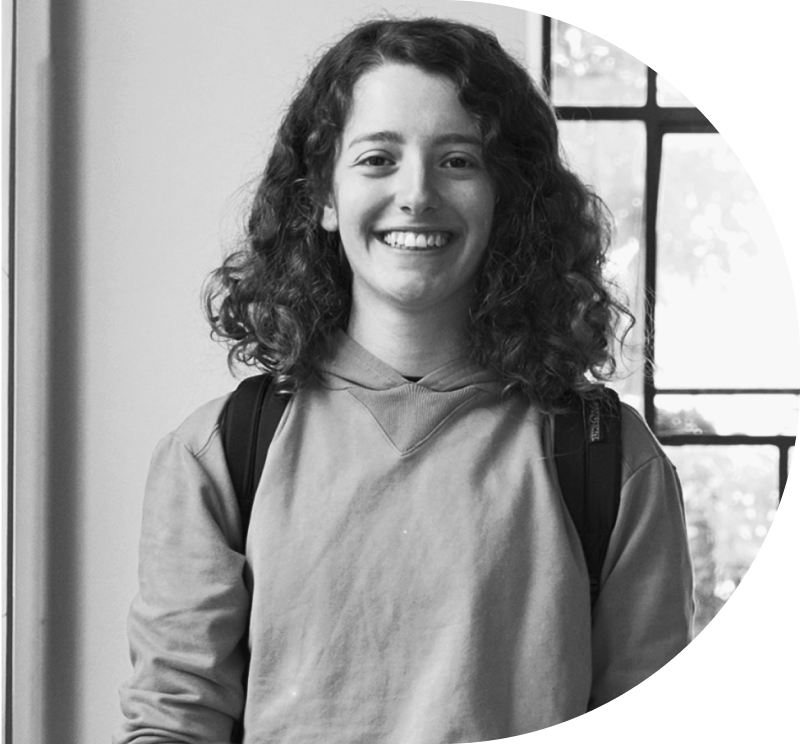
Giulia Reggio
Graduated in 2020, is now a medical student at USP
“The school is awesome! The teachers are always talking about teaching us beyond academics so that we can see the people around us, searching for a change we can leave to others so that this place can become a better place, one that we believe in.”
Dúvidas frequentes
É possível ingressar na Móbile no meio do ano letivo?
Sim. Consulte-nos sobre as séries em que há vagas remanescentes. Matrículas no decorrer do ano letivo, não necessariamente em agosto, ocorrem com frequência na Educação Infantil e nos anos iniciais do Ensino Fundamental.
Qual é a idade para ingresso na Móbile e quais são as idades por série?
A Móbile recebe alunos a partir do Infantil 2 em seu Programa Regular e a partir do Infantil 4 no Programa Bilíngue. A tabela a seguir informa a idade mínima para o ingresso em cada série da Educação Infantil ao 1º ano do Fundamental:

Para as demais séries – do 2º ao 9º ano do Fundamental e do 1º ao 3º ano do Ensino Médio –, o(a) estudante dará sequência a seus estudos conforme documentação registrada na Secretaria de Educação.
Por isso, na pré-matrícula será solicitada a Declaração de Escolaridade ou Transferência, a fim de conferirmos a adequação idade-série e o histórico do(a) aluno(a). Para estudantes egressos(as) de instituições internacionais, o ingresso será analisado caso a caso.
A Móbile organiza sorteios de vagas na Educação Infantil?
Não. As vagas são distribuídas por ordem de chegada, ou seja, pelo envio da ficha de Manifestação de Interesse por uma vaga. Para preencher esse documento, você deve ter feito sua inscrição em nosso Processo de Ingresso e participado de uma reunião de apresentação da Móbile. Clique aqui para se inscrever no Processo de Ingresso 2025.
Irmão(ã) de aluno(a) tem preferência no Ingresso?
Sim. Irmãos(ãs) de alunos(as) que estudam atualmente na Móbile, assim como filhos(as) de funcionários(as) e assessores(as) da Móbile, têm preferência no Ingresso quando há vagas disponíveis. Para tanto, devem preencher a Manifestação de Interesse dentro do prazo estabelecido em comunicação interna (no mês de maio de 2025).
Estudantes de 1º e 2º ano do Fundamental 1 realizam vivências?
Sim, agendamos vivências para que os novos estudantes conheçam a escola e nós possamos realizar um diagnóstico de ingresso, compartilhado pela coordenação com as famílias de cada aluno(a). As vivências de 1º e 2º ano não são classificatórias. Só participam delas estudantes para os quais já oferecemos uma vaga.
O que são as vivências de 3º ao 9º ano do Fundamental?
São dias em que os(as) estudantes do 3º ao 9º ano do Ensino Fundamental realizam avaliações diagnósticas de Português e Matemática (no Programa Bilíngue, também de Inglês). Eles também conhecem os espaços da escola e interagem com outros estudantes por meio de jogos, experiências e dinâmicas de grupo. Os resultados desta etapa constituem o principal instrumento de classificação e orientam nossas listas de aprovados e de espera para a matrícula. Ao mesmo tempo, nos ajudam a delinear um plano para a melhor adaptação do(a) estudante em nossa escola. Há uma taxa de R$ 400,00 reais para a participação nas avaliações de ingresso.
Como são as provas de ingresso para o Ensino Médio?
A avaliação para ingresso no Ensino Médio da Móbile é composta de instrumentos de Língua Portuguesa (produção de texto e questões discursivas de interpretação de texto) e Matemática. As provas são classificatórias e orientam nossas listas de aprovados e de espera. As avaliações contemplam atividades pedagógicas e de integração conduzidas pelos educadores da Móbile. Há uma taxa de R$ 400,00 reais para a participação nas avaliações de ingresso.
Conteúdo Programático - Ensino Fundamental
3rd grade
Reading and Text Production
Related to the reading procedures, it will be observed if the student:
reads fluently, assigning meaning to the words and sentences;
differentiates letters, syllables and words;
identifies explicit information in the text;
infers an implicit information in the text;
identifies the elements that build a narrative: characters, space, narrator and plot;
identifies the conflict generated from the plot;
establishes relationship between the parts and elements of the text;
interprets based on the text;
Related to the procedure of text production, it will be observed if the student:
uses cursive legible letters;
recognizes the word as a sound unity that is between two spaces, this way, avoiding possible juxtapositions/blended words;
explores punctuation at the end of the sentences (period, question mark, exclamation point);
uses uppercase letters in first names and beginning of sentences;
presents logical linking ideas in the construction of answers and text;
divides the paragraphs into phrases;
uses basic noun and verb agreement mechanisms.
Mathematics
Related to problem resolution procedures, it will be observed if the student:
elaborates valid strategies to solve problems of different mathematical thinking structures;
registers the carried out thought;
writes coherent final answers with the requested problem.
Related to the structure of the mathematical thinking, it will be observed if the student:
reads, writes and compares numbers until its order in the unit of thousands;
solves, through non-conventional strategies, problems involving different ideas of addition, subtraction, multiplication and division with natural numbers;
calculates addition precisely involving natural numbers through usual algorithm
calculates subtractions precisely with no exchange involving natural numbers through usual algorithm.
English (only for Bilingual Program candidates)
The learner CAN…
Recognize the letters of the alphabet in English;
Spell her/his name and simple words: school subjects, family members, colors, likes and dislikes, places in a school;
Unscramble letters to form words
Use simple sentences to ask and answer simple questions: This is a chair. / How old are you? / I am six (years old).
Answer simple, direct questions about an image;
Respond to classroom instructions accordingly: Read the text and circle the correct image. / Answer the questions;
Use very short sentences to describe familiar situations: This is my mother. / I like bananas. / I like dancing. / I am wearing glasses. / I can play outside. / There are four people in my family. / It is raining;
Read and understand short texts with visual support.
Label a picture using words and short sentences.
Topics
Name and age
Cardinal numbers
Months of the year
Likes and dislikes
Sports and physical activities
School activities and subjects
Family members
Structures
Be and have for simple descriptions
Can for abilities
There is / are
Basic pronouns
Basic present verb forms
4th grade
Reading and Text Production
Related to the reading procedures, it will be observed if the student:
reads fluently, assigning meaning to the words and sentences;
identifies explicit information in the text;
infers an implicit information in the text;
identifies the elements that build a narrative: characters, space, narrator and plot;
identifies the conflict generated from the plot;
infers meaning of a word or expression;
establishes relationship between the parts and elements of the text;
distinguishes a fact from the opinion related to this fact;
recognizes the meaning effect from the use of punctuation and other notations;
interprets texts in comic books;
interprets based on the text;
identifies direct discourse;
understands what’s stated in the activity.
Related to the procedure of text production, it will be observed if the student:
uses cursive legible letters;
recognizes the word as a sound unity that is between two spaces, this way, avoiding possible juxtapositions/blended words;
explores punctuation in every sentence (period, question mark, exclamation point, comma);
uses uppercase letters in first names and beginning of sentences;
presents logical linking ideas in the construction of answers and text;
divides the text in paragraphs;
divides the paragraphs into phrases;
uses basic noun and verb agreement mechanisms.
Mathematics
Related to problem resolution procedures, it will be observed if the student:
elaborates valid strategies to solve problems of different mathematical thinking structures;
registers all the steps of the solution;
writes coherent final answers with the requested problem.
Related to the structure of the mathematical thinking, it will be observed if the student:
reads, writes and compares numbers until its order in the unit of thousands;
solves, through non-conventional strategies, problems involving different ideas of addition, subtraction, multiplication and division with natural numbers;
relates information presented in a double entry table
solves, through non-conventional strategies, problems involving different ideas of addition, subtraction, multiplication and division with natural numbers;
calculates addition and subtraction precisely involving natural numbers through usual algorithm;
calculates multiplication precisely through usual algorithm when the second factor has only one algorithm.
English (only for Bilingual Program candidates)
The learner CAN…
Unscramble letters to form words in English;
Read and understand simple texts with little visual support;
Answer simple, direct questions with complete answers about a text;
Answer simple, direct questions about an image;
Produce simple sentences to talk about himself/herself: I have (got) a dog. / My mothers name is Anna. / My favorite school subject is Science. / I like (playing) soccer. / I live in a house with my parents and sister.
Produce simple sentences to describe a scene: The computer is next to the lamp. / This is a television. / There is a dog and a cat in the yard. / These books are blue. / She is bouncing the ball.
Label a picture using short sentences.
Topics
Name and age
Cardinal numbers
Months of the year
Likes and dislikes
Hobbies
Hobbies
Sports and physical activities
School activities and subjects
Family members
Structures
Be and have for simple descriptions
Can for abilities
Determiners (a, an, the, some)
There is/are for simple descriptions
Have (got) for possession
Personal and possessive pronouns
Present verb forms (simple & continuous)
Conjunctions (and, but, so)
5th grade
Reading and Text Production
Related to the reading procedures, it will be observed if the student:
reads fluently, assigning meaning to the words and sentences;
identifies explicit information in the text;
infers an implicit information in the text;
identifies the elements that build a narrative: characters, space, narrator and plot;
identifies the conflict generated from the plot;
infers meaning of a word or expression;
recognizes the meaning effect from the use of of a word or expression;
establishes relationship between the parts and elements of the text;
establishes relationship between the parts of the text, identifying repetitions and substitutions that contribute to the continuity of a text;
distinguishes a fact from the opinion related to this fact;
establishes relation between diverse texts;
recognizes the meaning effect from the use of punctuation and other notations;
interprets based on the text;
identifies direct discourse;
understands what’s stated in the activity.
Related to the procedure of text production, it will be observed if the student:
uses cursive legible letters;
recognizes the word as a sound unity that is between two spaces, this way, avoiding possible juxtapositions/blended words;
explores punctuation in every sentence (period, question mark, exclamation point, comma);
uses uppercase letters in first names and beginning of sentences;
presents logical linking ideas in the construction of answers and text;
divides the text in paragraphs;
divides the paragraphs into phrases;
uses basic noun and verb agreement mechanisms.
marks, in the text, the separation between the narrator’s discourse and the character’s speech, correctly using marks for this separation (reported speech verbs, colon, dash and quotation marks).
Mathematics
Related to problem resolution procedures, it will be observed if the student:
elaborates valid strategies to solve problems of different mathematical thinking structures;
elaborates an organized register with all the steps of the problem resolution;
writes coherent final answers with the requested problem.
Related to the structure of the mathematical thinking, it will be observed if the student:
reads, writes and compares numbers until its order in the unit of millions;
identifies the total units, dozens, hundreds, etc. of a number (inclusion relations);
solves problems involving the currency of our monetary system;
relates information presented in a double entry table
calculates addition and subtraction precisely involving natural numbers through usual algorithm;
English (only for Bilingual Program candidates)
The learner CAN…
Spell words more accurately and promptly;
Answer simple, direct questions with complete answers about a text;
Complete a text with the correct missing words;
Infer meaning of unknown words or chunks from context;
Write very short descriptive paragraphs involving close people, events, and/or familiar situations.
Topics
Name and age
Cardinal numbers
Months of the year
Likes and dislikes
Hobbies
Sports and physical activities
School activities and subjects
Family members
Structures
Verb to be
Like, enjoy, hate + noun/gerund
Adjective word order
Comparative degree of adjectives
Have (got) for descriptions
Demonstrative, personal and possessive pronouns
Present verb forms (simple & continuous)
Adverbs of time (yesterday, last, ago)
Can for present abilities
Could for past abilities
Will for future events
Conjunctions (and, but, too, because, so, then, when)
Ensino Fundamental 2:
Veja abaixo os conteúdos referentes às avaliações de Leitura, Produção de Texto, Matemática e Inglês para candidatos ao Ensino Fundamental 2
6th grade
Reading and Text Production
Related to the reading procedures, it will be observed if the student:
localiza informações explícitas no texto
infere informações implícitas no texto;
establishes relationship between the parts and elements of the text;
interpreta com base no texto;
understands what’s stated in the activity.
Em relação aos procedimentos de produção de texto, será observado se o(a) aluno(a):
uses cursive legible letters;
utiliza corretamente a pontuação no final e no interior das frases e nas enumerações;
apresenta encadeamento lógico das ideias na construção de textos;
adequately divides the text into periods and paragraphs;
uses basic noun and verb agreement mechanisms.
marca, no texto, a separação entre o discurso do narrador e a fala das personagens, utilizando adequadamente as marcas dessa separação (verbos de elocução, dois-pontos, travessão e aspas);
mantém a coerência textual na atribuição de título, na continuidade temática e de sentido geral do texto;
utiliza adequadamente os mecanismos de coesão por meio de pronomes, advérbios, conjunções, palavras do mesmo campo semântico;
grafa corretamente as palavras, obedecendo às normas da língua padrão;
emprega adequadamente a acentuação gráfica, obedecendo às diferenças de timbre (aberto/fechado) e de tonicidade (oxítonas, paroxítonas e proparoxítonas).
mantém a coerência textual na atribuição de título, na continuidade temática e de sentido geral do texto.
Mathematics
Em relação aos procedimentos de resolução de problema, será observado se o(a) aluno(a):
elaborates valid strategies to solve problems of different mathematical thinking structures;
elaborates an organized register to communicate all the steps of the problem resolution;
verifies the compatibility of the result found;
escreve respostas finais coerentes com a solicitação do problema.
Related to the structure of the mathematical thinking, it will be observed if the student:
reads, writes and compares numbers until its order in any size, understanding the characteristics of the decimal system numbers;
precisely presents calculations with addition, subtraction, multiplication and division of natural numbers;
solves problems involving proportional relationships;
graphically represents fractions and problem situations involving rational numbers;
solves problems involving fraction of quantity calculations.
English (only for Bilingual Program candidates)
Can-Do Descriptors (Skills Assessed)
By completing this task, the student should be able to:
Introduce themselves in writing.
Produce simple and brief descriptions in writing.
Write a sequence narrative.
Express personal opinions (like/dislike with reasons).
Identify something interesting or difficult and explain why.
Use basic punctuation and capitalization accurately.
Topics Involved
1. Personal information
◦ Name, age, and basic self-introduction phrases.
2. School Environment Vocabulary
◦ Classrooms, playground, library, teachers, students, activities.
3. Activities and Actions
◦ Simple verbs for routine actions: see, visit, play, read, write, talk.
4. Likes and Dislikes
◦ Expressing preferences and opinions (I like… because… / I didn’t like…).
5. Interesting/Difficult Experiences
◦ Adjectives and phrases for feelings: fun, interesting, difficult, easy, exciting.
6. Grammar and Language Functions
◦ Present Simple for facts (My name is… / I am… / I like…).
◦ Past Simple (basic) for recounting activities (I saw… / I did…)
◦ Use of connectors: and, or, but, because.
7. Writing Mechanics
◦ Short sentences, correct spelling, basic punctuation, and paragraph flow.
Structures
Telling the time
Present simple and continuous
Comparatives and superlatives
Past simple and continuous
Plans, intentions and predictions: going to
Predictions: will
Present perfect with for, since, still, just, already, ever, never
Relative clauses with that
Can for present abilities
Could for past abilities
Should for simple advice and suggestions
Countable and uncountable nouns
Prepositions of place (behind, between, next to, opposite)
Imperative verbs for directions
7th grade
Reading and Text Production
Related to the reading procedures, it will be observed if the student:
localiza informações explícitas no texto;
infere informações implícitas no texto;
establishes relationship between the parts and elements of the text;
interprets based on the text;
understands what’s stated in the activity.
Related to the procedure of text production, it will be observed if the student:
uses cursive legible letters;
utiliza corretamente a pontuação no final e no interior das frases e nas enumerações;
apresenta encadeamento lógico das ideias na construção de textos;
adequately divides the text into periods and paragraphs;
uses basic noun and verb agreement mechanisms.
marca, no texto, a separação entre o discurso do narrador e a fala das personagens, utilizando adequadamente as marcas dessa separação (verbos de elocução, dois-pontos, travessão e aspas);
mantém a coerência textual na atribuição de título, na continuidade temática e de sentido geral do texto;
utiliza adequadamente os mecanismos de coesão por meio de pronomes, advérbios, conjunções, palavras do mesmo campo semântico;
grafa corretamente as palavras, obedecendo às normas da língua padrão;
emprega adequadamente a acentuação gráfica, obedecendo às diferenças de timbre (aberto/fechado) e de tonicidade (oxítonas, paroxítonas e proparoxítonas).
mantém a coerência textual na atribuição de título, na continuidade temática e de sentido geral do texto.
Mathematics
Em relação aos procedimentos de resolução de problema, será observado se o(a) aluno(a):
elabora estratégias válidas para resolver problemas de diferentes estruturas de pensamento matemático;
elabora um registro de maneira a comunicar de forma organizada o percurso completo de sua resolução;
verifies the compatibility of the result found;
escreve respostas finais coerentes com a solicitação do problema.
Em relação às estruturas de pensamento matemático, será observado se o(a) aluno(a):
lê, escreve e compara números racionais de qualquer ordem de grandeza, compreendendo as características do sistema de numeração decimal;
relaciona as diferentes representações dos números racionais: decimal, fracionária, gráfica e percentual;
solves operations involving natural numbers;
resolve adição, subtração e multiplicação envolvendo números racionais positivos;
solves problems involving proportional relationships;
resolve problemas envolvendo frações e porcentagens por meio de diferentes recursos (representações gráficas e operações).
English (only for Bilingual Program candidates)
Can-Do Descriptors (Skills Assessed)
By completing this task, the student should be able to:
Introduce themselves briefly in a written text.
Produce a description in writing using appropriate verbs.
Express preferences and justify their choices.
Identify and explain a challenge.
State motivation and provide reasons.
Organize ideas logically into a coherent short text.
Use appropriate vocabulary related to school and activities.
Write using clear sentences, correct spelling, punctuation, and capitalization.
Topics involved
1. Personal Information
◦ Basic self-reference (about me).
2. School Environment and Activities Vocabulary
◦ Terms for different spaces (classroom, lab, playground, library) and activities (experiment, group work, reading, sports)
3. Expressing Preferences and Reasons
◦ Phrases like: My favorite activity was… because…
◦ Justifying opinions clearly.
4. Challenges and Difficulties
◦ Describing something hard and explaining why (It was difficult because…).
5. Future Intentions / Motivation
◦ Expressing interest in studying at the school (I want to study here because…).
6. Grammar and Language Functions
◦ Past Simple for recounting the day (I did, I saw, I participated).
◦ Expressing opinions and reasons with connectors (because, and, but, however, that is why).
◦ Basic future/purpose expressions (I want to study here to…).
7. Writing Mechanics
◦ Sequencing ideas logically (First… Then… After that… Finally…).
◦ Proper punctuation, capitalization, and spelling.
Lexical Structures
Invitations and offers: Would you like…? / Let’s…! / How about you? / Shall we…?
Prepositional phrases + verb –ing (be, fond of, be keen on)
Prepositions of time: in, on, at
Time expressions: ago, when, while, until, last (week, year, century), before/after, as soon as, by (+ past perfect), already, yesterday
Quantifiers: a/an, a lot of, many, much, some
Linkers: because, however, as well, also, too
Grammar Structures
Sentence word order: subject + verb + direct object
Verb to be
Has/have got
Present simple
Enjoy, like, love, hate + nouns & verbs –ing
Comparative and Superlative: regular and irregular forms
Past simple and continuous
Used to for past habits
Plans, intentions and predictions: going to
Predictions: will
First conditional
Present perfect with for, since, still, just, yet, already, ever, never
8th grade
Reading and Text Production
Related to the reading procedures, it will be observed if the student:
localiza informações explícitas no texto;
infere informações implícitas no texto;
infere o sentido de palavras ou expressões;
establishes relationship between the parts and elements of the text;
establishes relation between diverse texts;
interprets based on the text;
understands what’s stated in the activity.
Related to the procedure of text production, it will be observed if the student:
uses cursive legible letters;
utiliza corretamente a pontuação no final e no interior das frases e nas enumerações;
apresenta encadeamento lógico das ideias na construção de textos;
adequately divides the text into periods and paragraphs;
uses basic noun and verb agreement mechanisms.
marca, no texto, a separação entre o discurso do narrador e a fala das personagens, utilizando adequadamente as marcas dessa separação (verbos de elocução, dois-pontos, travessão e aspas);
mantém a coerência textual na atribuição de título, na continuidade temática e de sentido geral do texto;
utiliza adequadamente os mecanismos de coesão por meio de pronomes, advérbios, conjunções, palavras do mesmo campo semântico;
grafa corretamente as palavras, obedecendo às normas da língua padrão;
emprega adequadamente a acentuação gráfica, obedecendo às diferenças de timbre (aberto/fechado) e de tonicidade (oxítonas, paroxítonas e proparoxítonas);
mantém a coerência textual na atribuição de título, na continuidade temática e de sentido geral do texto.
Mathematics
Em relação aos procedimentos de resolução de problema, será observado se o(a) aluno(a):
elabora estratégias válidas para resolver problemas de diferentes estruturas de pensamento matemático;
elabora um registro de maneira a comunicar de forma organizada o percurso completo de sua resolução;
verifies the compatibility of the result found;
escreve respostas finais coerentes com a solicitação do problema.
Em relação às estruturas de pensamento matemático, será observado se o(a) aluno(a):
relaciona as diferentes representações dos números racionais: decimal, fracionária, gráfica e percentual;
calcula o valor de expressões numéricas envolvendo adição, subtração, multiplicação e divisão de números racionais positivos;
calcula o valor de expressões numéricas envolvendo adição e subtração de números racionais positivos;
resolve problemas envolvendo operações com frações e porcentagens;
identifica relações proporcionais em uma situação e as utiliza na resolução de um problema.
English (only for Bilingual Program candidates)
Can-Do Descriptors (Skills Assessed)
By completing this task, the student should be able to:
Write a structured text with an introduction, body, and conclusion.
Describe key experiences using past tense verbs and vivid details.
Identify and explain challenges, including how they handled them.
Express opinions and personal reflections.
Communicate future expectations and goals in a clear and organized manner.
Use linking words and cohesive devices (first, then, because, however, therefore, finally, at last.)
Demonstrate control of grammar and spelling, particularly:
◦ Past simple and past continuous for recounting the day.
◦ Present simple for opinions.
◦ Future or modal verbs for goals (I hope to, I want to, I will, I intend, I might, I may).
Employ topic-specific vocabulary (school life, activities, personal goals).
Topics involved
1. Recounting Experiences
◦ Past tenses (visited, was visiting, participated, was participating, learned, was learning).
◦ Details about activities, spaces, or interactions.
2. Memorable Moments
◦ Vocabulary for emotions and impressions (exciting, impressed, surprising, fun, interesting).
3. Challenges and Solutions
◦ Expressing difficulty (It was hard to…, I struggled with…) and strategies (I asked for help, I tried again).
4. Expressing Opinions
◦ Expressing uniqueness (What makes it special or different…).
◦ Using opinion markers (I believe / In my opinion, / What impressed me was…).
5. Expectations and Goals
◦ Future-oriented language (If I become a student, I want to… / I expect to learn…).
◦ Personal objectives (improve my English, make new friends, join clubs).
6. Text Structure and Cohesion
◦ Introductory sentence
◦ Logical sequencing of ideas
◦ Conclusion
7. Language Focus
◦ Past Simple & Past Continuous for recounting events.
◦ Present Simple for opinions.
◦ Future expressions for goals (will, going to, would like to).
◦ Connectors (because, however, therefore).
Lexical Structures
Related collocations and phrasal verbs
Chunks to describe large numbers
Verbs + dependent prepositions
Compound nouns
Make and do collocations -ed & -ing adjectives
Prepositional phrases with ‘at’ / ‘by’ / ‘in’ / ‘on’
Linkers: cause + effect / opinion / contrast
Grammar Structures
Verb tenses: present simple / continuous / perfect simple / perfect continuous
Narrative tenses: past simple and continuous / used to / past perfect simple
Pronouns: subject / object / adjective / reflexive
Defining and non-defining relative clauses
Future forms: will / going to / present continuous / present simple
Conditionals: zero / first / second
Reported speech
Passive Voice
Modal verbs: deduction / obligation / prohibition
9th grade
Reading and Text Production
Related to the reading procedures, it will be observed if the student:
localiza informações explícitas no texto;
infere informações implícitas no texto;
infers meaning of a word or expression;
establishes relationship between the parts and elements of the text;
establishes relation between diverse texts;
interpreta com base no texto.
Related to the procedure of text production, it will be observed if the student:
uses cursive legible letters;
utiliza corretamente a pontuação no final e no interior das frases e nas enumerações;
apresenta encadeamento lógico das ideias na construção de textos;
adequately divides the text into periods and paragraphs;
uses basic noun and verb agreement mechanisms.
mantém a coerência textual na atribuição de título, na continuidade temática e de sentido geral do texto;
utiliza adequadamente os mecanismos de coesão por meio de pronomes, advérbios, conjunções, palavras do mesmo campo semântico;
grafa corretamente as palavras, obedecendo às normas da língua padrão;
emprega adequadamente a acentuação gráfica, obedecendo às diferenças de timbre (aberto/fechado) e de tonicidade (oxítonas, paroxítonas e proparoxítonas).
mantém a coerência textual na atribuição de título, na continuidade temática e de sentido geral do texto.
Mathematics
Em relação aos procedimentos de resolução de problema, será observado se o(a) aluno(a):
elabora estratégias válidas para resolver problemas de diferentes estruturas de pensamento matemático;
elabora um registro de maneira a comunicar de forma organizada o percurso completo de sua resolução;
verifies the compatibility of the result found;
escreve respostas finais coerentes com a solicitação do problema.
Em relação às estruturas de pensamento matemático, será observado se o(a) aluno(a):
relaciona as diferentes representações dos números racionais: decimal, fracionária, gráfica e percentual;
resolve problemas envolvendo operações com frações e porcentagens;
calcula o valor de expressões numéricas envolvendo adição, subtração, multiplicação e divisão de números racionais;
calcula o valor de potências com base racional e expoente natural;
identifica relações proporcionais em uma situação e as utiliza na resolução de um problema;
resolve problemas envolvendo operações com frações e porcentagens;
utiliza recursos algébricos para representar e resolver uma situação apresentada;
solves first degree equations.
English (only for Bilingual Program candidates)
Can-Do Descriptors (Skills Assessed)
By completing this task, the student should be able to:
Describe an experience.
Explain what makes something special based on observation.
Narrate challenges and detail a possible course of action towards a solution.
Write detailed descriptions using appropriate descriptive language.
Share personal reflections.
Write about personal goals and expectations for the future.
Use a range of past tenses accurately to talk about experiences and actions.
Use future forms to express expectations and ambitions (I will, I hope to).
Structure the text into an introduction, body, and conclusion.
Use linking words to connect ideas logically (because, although, however, therefore, first, then, furthermore, at last, finally, in conclusion).
Topics involved
Personal Experience
School Features
Challenges and Solutions
Self-Discovery
Future Goals
Lexical Structures
Linkers of addition
Linkers of contrast
Goods and services
Sales and marketing
Seem, look and appear
So and neither
Likely to and expected to
Dwellings and furniture
Health conditions, symptoms and ailments
Unless, as long as and in case for conditionals
Wish and if only
Feel, have and be
Grammar Structures
Causative have
Relative pronouns
Prepositional relative clauses
Noun suffixes: -full, -ment, -ion, -ity, -er, -or, -hood, -ism, -ist, -ness
Noun prefixes: anti-, dis-, in-, co-, extra-, fore-, mis-, mono-, bi-
Adjective suffixes: -y, -less, -able, -ible, -ful, -ish
Indirect questions
Participle clauses
Conteúdo Programático - Ensino Médio
The diagnostic evaluations aim to see the stage of development of the student related to the content listed below.
1st grade - High School
Portuguese Language
Leitura:
Select adequate reading procedure.
Infer the meaning of a word or expression.
Find explicit information in a text.
Infer an implicit information in the text.
Establish relationships between the parts of a text, identifying repetitions and substitutions that contribute to its continuity.
Identify logical-discursive relationships presented in the text, marked by conjunctions, adverbs, etc.
Recognize the effect of the meaning from the use of punctuation, the choice of certain words and expressions, order of the information, etc.
Identify effects of irony or humor in diverse texts.
Relate the text with its production conditions: genre, circulation forms, objectives, etc.
Identify the theme of a text.
Identify the thesis of an argumentative text.
Establish a relationship between the thesis and the arguments offered to sustain it.
Distinguish a fact from the opinion related to this fact;
Recognize the different positions between two or more opinions related to the same fact or theme.
Interpret, in poems, effects produced by the use of sound resources (stanza, rhymes, alliterations, etc.) and semantic (figures of speech, for example).
Articulate the verbal language with other languages (photographs, illustrations, etc.).
Establish relationships between texts.
Text production:
Answer to the proposed genre, distinguishing its constituent elements (related to the content, compositional construction and style).
Keep to the proposed theme and develop it.
Adequately select and relate information and arguments.
Keep textual coherence, including in the attribution of a title.
Adequately divide the text into paragraphs and periods.
Adequately divide the text into paragraphs and periods.
Establish relationship between the parts of the text, identifying repetitions and substitutions that contribute to the continuity of a text;
Write the words correctly, obeying the norms of the dialect;
Adequately use punctuation: in the end and middle of sentences, to isolate apposition, vocative and anticipated adverbial adjunct.
Adequately use of noun and verb agreement mechanisms.
Mathematics
Numbers:
Solution of situation-problems involving one or more operations between real numbers.
Calculation and simplification of radical expressions.
Solution of problems involving direct quantities and inversely proportional.
Percentage calculation.
Notions of probability of simple event occurrence.
Notable products.
Factoring.
Equation resolution and first degree equation systems.
Resolution of situation-problems involving first degree equations.
Resolução de situações-problema envolvendo equações de 2º grau.
Geometry and measurements:
Angular properties: addition of internal angles of a polygon, opposite angles by the vertex, supplementary and complementary.
Polygons: classification, properties, areas and perimeters.
Circumferences and circles; perimeters and area.
Similarities of triangles.
Units of measurements of different sizes: volume, mass, time, length and area.
Relationships between measures of expressive qualities because of: speed, density, etc.
Notions of statistics:
Reading, construction and interpretation of graphs of sectors, bars and segments.
Calculation and interpretation of average value of a group of data.
2nd grade - High School
Portuguese Language
Reading:
Select adequate reading procedure.
Infer the meaning of a word or expression.
Find explicit information in a text.
Infer an implicit information in the text.
Establish relationships between the parts of a text, identifying repetitions and substitutions that contribute to its continuity.
Identify logical-discursive relationships presented in the text, marked by conjunctions, adverbs, etc.
Recognize the effect of the meaning from the use of punctuation, the choice of certain words and expressions, order of the information, etc.
Identify effects of irony or humor in diverse texts.
Relate the text with its production conditions: genre, circulation forms, objectives, etc.
Identify the theme of a text.
Identify the thesis of an argumentative text.
Establish a relationship between the thesis and the arguments offered to sustain it.
Distinguish a fact from the opinion related to this fact;
Recognize the different positions between two or more opinions related to the same fact or theme.
Interpret, in poems, effects produced by the use of sound resources (stanza, rhymes, alliterations, etc.) and semantic (figures of speech, for example).
Articulate the verbal language with other languages (photographs, illustrations, etc.).
Establish relationships between texts and artistic languages.
Text production:
Answer to the proposed genre, distinguishing its constituent elements (related to the content, compositional construction and style).
Keep to the proposed theme and develop it.
Adequately select and relate information and arguments.
Use expressive resources adequately and articularly, taking into account the effects of meaning intended.
Adequately divide the text into paragraphs and periods.
Adequately divide the text into paragraphs and periods.
Establish relationship between the parts of the text, identifying repetitions and substitutions that contribute to the continuity of a text;
Write the words correctly, obeying the norms of the dialect;
Adequately use punctuation: in the end and middle of sentences, to isolate apposition, vocative and anticipated adverbial adjunct.
Adequately use of noun and verb agreement mechanisms.
Specific content:
Language and speech.
Language variety.
Teoria da comunicação e funções da linguagem (Jakobson).
Denotation/connotation.
Structure and word formation.
Phonology notions: phoneme. vowel, semivowel, digraph, etc.
Literary genres: epic, lyrical and dramatic.
Literary schools - production context, themes, expressive resources and exponents: Troubadourism, Humanism, Classicism, 16th Century.
Mathematics
Além do conteúdo programático para candidatos(as) ao 1° ano, os(as) candidatos(as) ao 2° ano devem saber:
Numbers and Functions:
First and second degree functions: graphs, roots and properties.
Resolution of situation- problems involving 1st and 2nd degree functions.
Functions defined by parts.
Exponential functions.
Logarithm: definition and properties.
Resolution of problems involving logarithmic functions and/or exponentials
Arithmetic and geometric progressions.
Simple and compound interest.
Geometry/Trigonometry:
Metric relation in rectangle triangles, Pythagorean theorem.
Trigonometry reasons in rectangle triangles.
Resolution of any triangles, sine and cosine law.
Inscription and constituency in regular polygons.
3rd grade - High School
Portuguese Language
Reading:
Select adequate reading procedure.
Infer the meaning of a word or expression.
Find explicit information in a text.
Infer an implicit information in the text.
Establish relationships between the parts of a text, identifying repetitions and substitutions that contribute to its continuity.
Identify logical-discursive relationships presented in the text, marked by conjunctions, adverbs, etc.
Recognize the effect of the meaning from the use of punctuation, the choice of certain words and expressions, order of the information, etc.
Identify effects of irony or humor in diverse texts.
Relate the text with its production conditions: genre, circulation forms, objectives, etc.
Identify the theme of a text.
Identify the thesis of an argumentative text.
Establish a relationship between the thesis and the arguments offered to sustain it.
Distinguish a fact from the opinion related to this fact;
Recognize the different positions between two or more opinions related to the same fact or theme.
Interpret, in poems, effects produced by the use of sound resources (stanza, rhymes, alliterations, etc.) and semantic (figures of speech, for example).
Articulate the verbal language with other languages (photographs, illustrations, etc.).
Establish relationships between texts and artistic languages.
Text production:
Answer to the proposed genre, distinguishing its constituent elements (related to the content, compositional construction and style).
Keep to the proposed theme and develop it.
Adequately select and relate information and arguments.
Use expressive resources adequately and articularly, taking into account the effects of meaning intended.
Adequately divide the text into paragraphs and periods.
Adequately divide the text into paragraphs and periods.
Establish relationship between the parts of the text, identifying repetitions and substitutions that contribute to the continuity of a text;
Write the words correctly, obeying the norms of the dialect;
Adequately use punctuation: in the end and middle of sentences, to isolate apposition, vocative and anticipated adverbial adjunct.
Adequately use of noun and verb agreement mechanisms.
Specific content:
Language and speech.
Language variety.
Teoria da comunicação e funções da linguagem (Jakobson).
Classes de palavras: identificação, flexão e emprego.
Literary genres: epic, lyrical and dramatic.
Literary schools - production context, themes, expressive resources and exponents: Baroque, Arcadeism, Romanticism, Realism and Naturalism.
Mathematics
Além dos conteúdos programáticos para candidatos(as) ao 1° e ao 2° ano, os(as) candidatos(as) ao 3° ano devem saber:
Numbers and Functions:
Logarithmic function: definition, properties, graphs, equation e inequalities.
Resolution of problems involving logarithmic functions and/or exponentials
Geometry/Trigonometry:
Measurement of arches and angles, trigonometric circumference.
Trigonometric functions: sine, cosine and tangent.
Equations with sine, cosine and tangent.
Relative position between lines, lines and planes, planes.
Main polyhedron: prisms and pyramids.
Square bodies: cylinders and cones.
Notable points of a triangle.
Treatment of information
Probabilities: simple. conditional and binomial.
Combinatory analysis: grouping cases.
Pascal’s triangle and Newton's binomial.
Construction, reading and interpretation of data represented in tables and/or statistical graphs.
Calculation and interpretation of the mean, median and mode in a group of discrete values
Calculation and interpretation of dispersion measures: variance and standard deviation.
Quais são as etapas e os documentos necessários para a matrícula?
O processo de matrícula ocorre em dois tempos:
Reserva de Vaga - Pagamento, no prazo de 3 dias úteis, de taxa que compõe a anuidade e garante a vaga do(a) estudante após convocação pela equipe de Ingresso.
Matrícula - Será efetivada de forma 100% digital, por meio da Área Exclusiva para famílias Móbile, após confirmação da reserva de vaga.
Neste processo, que deve ser realizado em até 4 dias, solicitamos os seguintes documentos:
• preenchimento de ficha de dados cadastrais dos(as) responsáveis e do(a) aluno(a);
• assinatura do contrato de prestação de serviços educacionais;
• declaração de quitação das mensalidades da escola em que o(a) aluno(a) estuda em 2025;
• documento da escola de origem comprovando a escolaridade do(a) aluno(a);
• cópia do RG com CPF;
• cópia da Certidão de Nascimento (já requerida na Manifestação de Interesse);
• foto de rosto do(a) estudante (já requerida na Manifestação de Interesse);
• histórico escolar original (entrega em até 30 dias após a matrícula);
• certificado de conclusão do Ensino Fundamental para ingressantes no Ensino Médio (entrega em até 30 dias após a matrícula);
• Report Card ou Transcript, com tradução juramentada, para estudantes que moravam no exterior ou realizaram intercâmbio (entrega em até 30 dias após a matrícula).
Baixe aqui o PDF com a lista detalhada dos documentos para facilitar sua organização.
Qual é a metodologia da Móbile?
A Móbile possui um currículo autoral, constantemente atualizado por sua equipe pedagógica, de modo a refletir o espírito e as necessidades dos tempos em que vivemos. Estruturamos nossas metodologias de ensino-aprendizagem para desenvolver, ao mesmo tempo, a autonomia moral e a formação intelectual e acadêmica de nossos(as) alunos(as). Em outras palavras, promovemos o pensamento crítico e a capacidade de dialogar com o outro e com o mundo que nos rodeia. Na seção “A escola”, você encontrará mais informações sobre nossa proposta pedagógica.
O que significa a associação entre a Móbile e a Nord Anglia Education?
Significa que, além dos sócios Maria Helena Bresser (fundadora e diretora-geral pedagógica) e Daniel Bresser (diretor-geral executivo), a Escola Móbile tem, desde 2024, um novo sócio: o grupo internacional de educação Nord Anglia Education. Assim como a Móbile, a Nord Anglia Education tem como missão desenvolver a confiança, a resiliência e a criatividade de seus(suas) estudantes, que, dessa maneira, podem - além de conquistar resultados acadêmicos excepcionais - realizar com sucesso seus projetos de vida.
Como a Móbile administra casos de bullying?
A Móbile possui um protocolo específico para a prevenção e pronta atuação em casos de bullying. Para acessar esse material, clique aqui.
A Escola adota livros didáticos ou sistemas apostilados?
A maior parte dos materiais didáticos da Móbile, digitais ou físicos, é formulada por seus(suas) próprios(as) professores(as), sob supervisão de coordenadores(as) e diretores(as) pedagógicos(as). A Móbile valoriza os conhecimentos científicos, tecnológicos e artísticos construídos pela humanidade e trabalha significativamente esses saberes por meio de um conteúdo educacional autoral e de metodologias de ensino-aprendizagem inovadoras, que colocam o(a) estudante como protagonista, vivenciando e refletindo de maneira crítica sobre seu próprio aprendizado.
Há um programa bilíngue na Móbile?
Há, na Móbile, duas opções de currículo, ambos bastante potentes: o Programa Bilíngue (em período integral) e o Programa Regular (em período parcial).
O Programa Bilíngue da Móbile segue um currículo internacional?
Não. Tanto o Programa Regular quanto o Bilíngue têm como base o currículo autoral da Móbile, em diálogo com o que exige a Base Nacional Comum Curricular (BNCC) brasileira. A experiência de 50 anos da Móbile possibilitou a criação desses dois programas, ambos marcados pela excelência acadêmica. Dessa forma, os(as) alunos(as) e as famílias podem escolher qual desses percursos atende melhor aos seus projetos de vida, tendo a certeza de que os dois programas garantem acesso às melhores instituições de ensino do Brasil e do mundo depois que os(as) estudantes se formam. Para compreender como se dá a inserção das aprendizagens em inglês e português em nosso Programa Bilíngue, sugerimos a leitura da seção Programa Bilíngue.
A Móbile oferece serviço de transporte escolar?
A Móbile sugere duas empresas que usualmente oferecem este tipo de serviço às nossas famílias:
Empresa Transid
- Responsáveis: Linda e Sidinei
- Telefones: (11) 99993-6230
- E-mail: lindaribeiro@terra.com.br
- Bairros atendidos: Campo Belo, Chácara Klabin, Moema, Vila Mariana e Vila Nova Conceição
TransportesEmpresa Edson
- Responsável: Edson
- Telefones: (11) 99614-4112 ou (11) 4332-2843
- E-mail: edsontransportes@yahoo.com.br
- Bairros atendidos: Brooklin Novo, Itaim, Jardins, Morumbi, Pinheiros e Vila Olímpia.
O uso de uniforme é obrigatório na Móbile?
O uso do uniforme na Móbile é opcional. Sua não obrigatoriedade deve-se a um princípio simples: as pessoas devem ter liberdade de escolher como se vestir e de se expressar nos diferentes ambientes e contextos. Caso a família opte por adquirir o uniforme, poderá providenciá-lo na empresa Texblun: Endereço: Loja 1 – Rua Manoel da Nóbrega, 1126 – Jardim Paulista; telefones: (11) 3051-3252 / 3051-3179 / 3052-1749.
Como é a alimentação na Móbile?
As cantinas, onde os(as) estudantes a partir do 2º ano do Ensino Fundamental podem adquirir lanches, e os serviços de almoço e lanche, que compõem a rotina no Programa Bilíngue, no Contraturno e no Inglês Móbile (com algumas especificidades de acordo com os cursos), são operados pela Quitanda, nossa parceira.
Fornecedora da Móbile desde 2023, essa empresa oferece uma alimentação diversa, composta de grãos, legumes, frutas e verduras, sem deixar de também incluir, com equilíbrio, outros alimentos apreciados por crianças e adolescentes. Todo o cardápio da Quitanda é elaborado e acompanhado diariamente por nutricionistas. Temos, além disso, cozinhas internas para realizar o preparo das refeições.
Que tipo de atividade a Móbile oferece além do horário de aula?
Oferecemos dezenas de opções de cursos opcionais (pagos) e atividades extracurriculares (sem custo adicional). Possuímos também um prédio exclusivo para a realização dos cursos opcionais do Inglês Móbile e um espaço de Contraturno, onde recebemos crianças de 2 a 8 anos, e ampliamos nosso compromisso em garantir o desenvolvimento por meio do brincar. Conheça mais sobre as modalidades navegando no menu Currículo Móvel de nosso site.
Precisa de ajuda?
Entre em contato com a nossa equipe de ingresso
